Understanding barriers and drivers of tick prevention behaviours among Canadian park visitors
Impact Canada, Impact & Innovation Unit, Privy Council Office
Key Insights
- Communications should focus on increasing the uptake of specific tick bite prevention measures (i.e., those taken specifically to prevent insect bites, rather than serving a dual function), like full-body tick checks. These measures are more effective but used less frequently than non-specific measures (i.e., actions that serve a dual function), like wearing closed-toe shoes.
- Self-reported knowledge about ticks and tick-borne diseases is a key predictor of tick bite prevention behaviour, emphasizing the need to continue promoting awareness of the risk of tick bites when outdoors.
- Park visitors who report greater difficulty planning ahead tend to engage in tick bite prevention behaviours less frequently, suggesting that timely prompts (e.g., alerts when arriving at a park/paying for parking) may be an effective, low-cost solution.
- Perceived social norms are the strongest predictor of tick bite prevention behaviours. Reinforcing explicit social norms (e.g., signage about staying on paths) or emphasizing dynamic social norms (e.g., how many more Canadians took action this year compared to last year) may help boost engagement.
- Healthcare workers and pharmacists are highly trusted sources of tick and tick-borne disease information, which suggests that they should be leveraged when communicating about ticks and tick-borne diseases.
Background
Parks and natural spaces have gained popularity in recent years (Eykelbosh & Chow, 2022; PARCA Wave 6, 2022) as many have recognized their physical and psychological benefits (Crouse et al., 2021; Lemieux et al., 2015; Reining et al., 2021) and contributions to climate change resilience (e.g., air quality improvements, mitigating flooding, etc.). While Canadians are spending more time in natural spaces, their communities have also focused on developing urban green infrastructure to maximize health and climate benefits. Given the increasing engagement with nature, it is important that people in Canada understand the risks of nature and take action to protect themselves so they can safely enjoy it.
Notably, climate change is resulting in rising temperatures and shorter winters, increasing the survival, range, and abundance of ticks and exacerbating the spread of tick-borne infectious diseases in Canada (Gage et al., 2008; Ogden et al., 2009). The national annual incidence of Lyme Disease, for instance, has drastically increased in recent years – reaching 2,634 recorded cases in 2019 (Gasmi et al., 2022) – and it is the most prevalent vector-borne disease in temperate regions (Githeko et al., 2000). Efforts to mitigate human exposure and infection are therefore critical to effectively manage Canadians’ disease risk. One way to accomplish this objective is to empower individuals to engage in personal preventive measures that reduce the risk of tick bites and/or disease transmission.
Past interventions to increase the uptake of infectious disease prevention measures (e.g., the use of tick repellent and protective clothing) have primarily been educational in nature (Coderre-Ball et al., 2021; Mowbray et al., 2012), and recent public opinion research has shown that Canadians generally possess high levels of awareness and knowledge about this topic. For example, 89% of respondents reported that they had heard of Lyme disease, 67% correctly noted that ticks can be found in their area, 91% acknowledged that visiting the outdoors puts them at risk of a tick bite, and 60% reported knowing how to protect themselves from being bitten by a tick. Rates of preventive measure use, however, are much lower (Aenishaenslin et al., 2017; Brady et al., 2022), indicating that there are additional barriers that have created a persistent gap between knowledge/awareness and preventive action.
The Public Health Agency of Canada’s Behavioural Science Office and Infectious Disease and Climate Change Program and the Privy Council Office’s Impact Canada therefore conducted an online survey of the barriers and drivers of tick prevention behaviour to better understand how to empower Canadian park visitors to take action to protect themselves and their families when outdoors.
Methodology
The survey was administered in February and March 2024 to a sample of 3,171 Canadian park visitors through Qualtrics – an online survey platform that recruits from existing pools of participants who have agreed to be contacted for research studies. Respondents were only eligible to participate if they were 18 years of age or older, lived in Canada, and had visited a park or natural space at least three times during the past tick season (April-October 2023) to engage in one or more of the following outdoor activities: hiking, nature walks/sightseeing, trail running/jogging, camping, mountain biking, golfing, bird watching, and/or fishing (from land; see Figure 1). For the purposes of this survey, “a park or natural space” could include any urban greenspace, private forest, hiking trail, community or municipal park, or Crown land, and did not need to be a national or provincial park. Of the three types of formal parks examined (i.e., national, provincial/territorial, and municipal), municipal parks were the most popular, with 75% reporting that they visited a municipal park in the past year.
Over half (56%) of respondents reported living in a large urban population centre (i.e., 100,000+ people), and 69% were categorized as residing in a high-risk area based on their postal code (specifically, their forward sortation areas [FSA]) and Lyme disease surveillance data for 2023). A range of ages was also represented, with 26% of respondents between 18 and 34 years, 36% between 35 and 54 years, 15% between 55 and 64 years, and 23% aged 65 years or older. Just over half (53%) of respondents identified as women, 46% as men, and 0.4% selected another gender identity. Further, 18% identified as a visible minority, 11% reported a disability, and 5% identified as Indigenous (4% First Nations, 2% Métis, and 0.2% Inuk).
The survey also included an oversample of 1,143 parents. At the time of the survey, 32% of parent respondents had at least one child under the age of 6 years, 45% had at least one child between the ages of 6 and 11 years, and 40% had at least one child between the ages of 12 and 17 years. Approximately half of parent respondents (51%) identified as men, and the majority were categorized as residing in a high-risk area for ticks (71%). From April through October of 2023, most parents (71%) visited a park or natural space with their children.
All survey respondents were provided with a list of recommended tick prevention behaviours and were asked to indicate the frequency with which they had used each measure when visiting parks or natural spaces from April through October of the previous year. Respondents were also asked to report on a series of drivers and barriers to their tick prevention behaviour, such as their subjective and objective knowledge, planning difficulties, social norm perceptions, resource constraints, and efficacy perceptions. These barriers and drivers were organized according to the COM-B Model, which is a framework of behaviour change. The COM-B model indicates that the following factors impact Behaviour: Capability (one’s physical and psychological ability to accomplish a behaviour), Opportunity (the environment/external factors that make a behaviour possible), and Motivation (the internal, cognitive processes that drive behaviour in the moment).
Findings
Specific tick prevention behaviours are engaged in less frequently than non-specific prevention behaviours
Overall, respondents reported using a range of prevention measures to protect themselves from ticks when visiting parks or natural spaces during the tick season. As seen in Figures 2 and 3, the top three most frequent measures were wearing closed-toe shoes (83% ‘often’ or ‘always’ use), walking only on cleared paths or trails (79%), and taking a shower or bath after coming back from the outdoors (62%). The three least frequent were wearing permethrin-treated clothing (17%), putting clothes in the dryer on high heat (33%), and tucking pants into socks (35%).
Respondents were more likely to engage in non-specific tick prevention behaviours (i.e., actions that serve a dual function, such as wearing a hat or long-sleeved clothing) compared to specific tick prevention behaviours (i.e., actions that are intentionally taken for the purpose of preventing insect bites and infectious disease, rather than serving a dual function).
Parents also report using specific tick prevention behaviours less frequently than non-specific measures to protect their children
Parent respondents also reported using a range of preventive measures to protect their children when visiting parks or natural spaces. The three most frequent measures included dressing their children in closed-toe shoes (78%), ensuring that their children wore hats (72%), and ensuring that their children covered exposed skin (64%). The three least frequent were putting their children’s clothes in the dryer on high heat (42%), tucking their children’s pants into their socks (49%), and dressing their children in light-coloured clothing (51%; see Figures 4 and 5). Similar to park visitors in general, parent respondents reported greater engagement in specific tick prevention behaviours than non-specific behaviours.
Self-rated knowledge and planning challenges are associated with reduced engagement in tick prevention behaviours
Respondents rated how knowledgeable they think they are about ticks and tick-borne diseases on a 7-point scale. Overall, 47% rated themselves as having high subjective knowledge (i.e., a score from 5-7), while 28% rated themselves as having low subjective knowledge (i.e., a score from 1-3). Notably, respondents who rated themselves as having low knowledge about ticks and tick-borne diseases were less likely to use prevention measures frequently (see Figure 6).
We also examined respondents’ awareness of the risk of Lyme disease in their province/territory. Overall, 32% of respondents were unsure about the level of risk in their province/territory and, among those who indicated knowing their level of risk (i.e., those who selected a risk level; n = 2149), only 46% were accurate in their assessments. Across all regions, a smaller proportion of respondents from the Atlantic region were accurate, followed by the Prairies and British Columbia.
Another factor that can impact tick prevention behaviour is one’s capacity for planning. Given that several tick prevention behaviours require specific equipment/clothing (e.g., insect repellent, long-sleeved clothing) or must be engaged in at a specific time (i.e., when one returns from the outdoors), it is important that park visitors are able to plan in advance. Accordingly, respondents were asked to rate their agreement with two statements – one assessing how difficult it is to prepare for the outdoors and one assessing how difficult it is to engage in prevention measures after being outdoors. About a third of respondents (36%) noted difficulties in preparing for the outdoors, while 42% acknowledged difficulties engaging in prevention measures after being outdoors.
On average, respondents underestimate the percentage of other park visitors taking action to protect themselves from ticks and tick-borne diseases
Numerous investigations have shown that people are particularly influenced by their social contexts and perceptions of social norms. Social norms are collectively-held expectations or rules for behaviour within a group, and they can be explicit (e.g., a sign asking you to stay on a trail) or implicit (e.g., seeing most park visitors staying on the park trail). In our survey, respondents rated their agreement with two social norm statements: one assessing descriptive norms (i.e., their perceptions of others’ tick prevention behaviour), and one assessing injunctive norms (i.e., their perceptions of others’ approval or disapproval of tick prevention behaviour). In response to the descriptive norms statement, 44% of respondents agreed that most of their friends and family are taking action to protect themselves, while 29% disagreed. In response to the injunctive norms statement, 51% of respondents agreed that the people close to them generally expect that they are taking action to protect themselves, while only 21% disagreed. Notably, respondents who used preventive measures less frequently (i.e., ‘never’ or ‘rarely’) were less likely to perceive tick prevention as a widespread norm (see Figure 7).
Another important social influence on behaviour is social consensus perceptions (i.e., perceptions of others’ agreement with certain beliefs or their engagement in certain behaviours). For instance, when asked to estimate the percentage of Canadians who took preventive measures to protect themselves from ticks and tick-borne diseases between the months of April through October of last year, the average estimate of survey respondents was 32.4% (SD = 21.7%). This perceived rate of tick prevention behaviour is much lower than the actual rate of engagement. When respondents were initially asked whether they had taken preventive measures against ticks and tick-borne diseases in the past year, 50% reported ‘often’ or ‘always’ using at least one specific prevention measure, while rates for non-specific measures were even higher.
External factors, including availability, cost, and overwhelming choices, limit engagement in tick prevention behaviours
In addition to the social environment, tick prevention behaviour can be influenced by external factors or prompts within the physical environment. For example, 36% of respondents reported that the appropriate equipment is difficult to find/not available in their area, 36% reported that the appropriate equipment is too expensive, and 57% reported that it is often too hot outside to wear protective clothing in parks. Further, a third of respondents reported choice overload (36%) or feeling like there are too many prevention strategies to engage in them all. Unfortunately, however, choice overload can lead to choice paralysis, where having too many options may prevent people from choosing to use any preventive measures at all.
Most respondents trust the Government of Canada as a source of information on ticks and tick-borne diseases
Another factor that can impact the uptake of tick prevention behaviour is the level of trust one has in the source of health warning information about ticks and tick-borne diseases. Respondents were asked to rate the extent to which they trust a range of information sources about this topic, and although healthcare professionals (89%) and pharmacists (87%) were the most trusted sources of tick and tick-borne disease information, 78% of respondents also reported trusting the Government of Canada as a source of information on ticks and tick-borne diseases. In contrast, social media sources, such as TikTok (53% distrust) and Twitter/X (47% distrust), were distrusted by more respondents than trusted, highlighting that where the message comes from is important.
Most respondents feel capable of engaging in preventive measures
To engage in tick prevention behaviour, one must also feel capable of following through (i.e., have self-efficacy). Notably, when respondents were asked to how capable they feel of protecting themselves from ticks and tick-borne diseases when visiting parts, only 10% reported feeling incapable. However, those who reported engaging in prevention measures less frequently had significantly lower self-efficacy ratings than those engaging in these measures more frequently (see Figure 8).
Perceived social norms and subjective knowledge have the largest unique impacts on the frequency of tick prevention
We explored the data using a multivariable linear regression model to help identify which factors had the largest unique impacts on the frequency of engagement in tick prevention behaviour (i.e., a mean frequency score was computed by combining frequency ratings for all specific and non-specific tick prevention behaviours). This model (see Figure 9), with 10 barriers/drivers, accounted for 41% of the differences observed in tick prevention. The largest positive predictors in our model were perceived social norms and subjective knowledge. In particular, the more respondents perceived tick prevention as a socially normative choice, and the greater respondents’ subjective knowledge of ticks and tick-borne diseases, the more frequently they engaged in tick prevention behaviours themselves.
Figure 9. Multivariable regression identifying key factors influencing how often people engage in tick prevention behaviours.
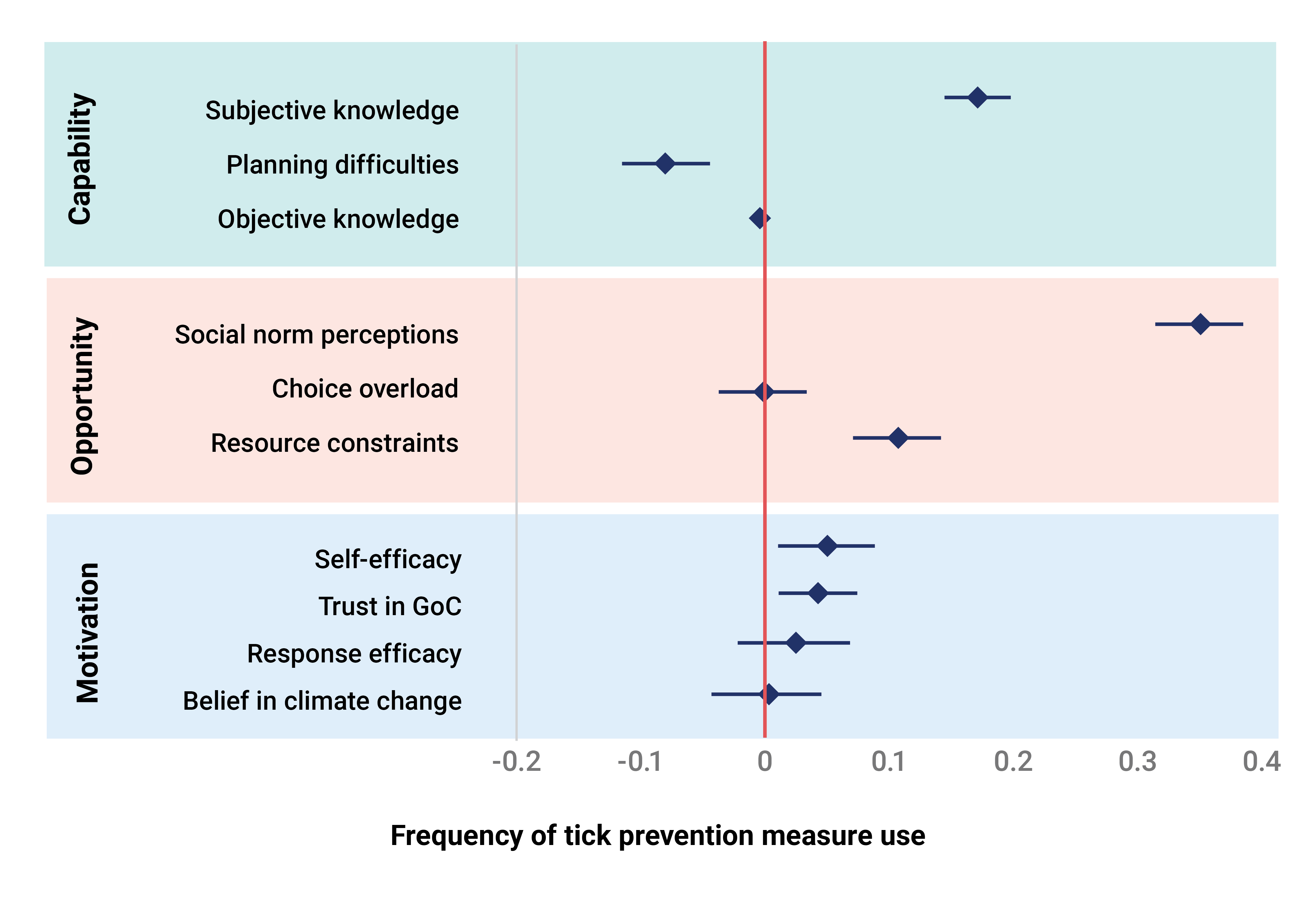
Text version
A forest plot displaying the association between various psychological and situational factors and the frequency of tick prevention measure use. The x-axis represents the effect size (B) ranging from approximately -0.2 to 0.4. A red vertical line at 0 indicates no effect. The y-axis lists factors grouped into three categories: Capability (green background), Opportunity (pink background), and Motivation (blue background). Each factor is accompanied by a horizontal confidence interval bar
Social norm perceptions (B = 0.347, 95% CI [0.32, 0.374]), subjective knowledge (B = 0.14, 95% CI [0.122, 0.158]), and resource constraints (B = 0.094, 95% CI [0.066, 0.122]) show the strongest positive associations, while planning difficulties (B = -0.057, 95% CI [-0.084, -0.029]) shows a negative association.
Next Steps
This study revealed that many Canadian park visitors are not consistently implementing tick prevention measures, especially those that are specific and more effective (e.g., applying synthetic insect repellent, conducting tick checks). Fortunately, survey results also highlight opportunities to support the adoption and uptake of prevention behaviours through the application of behavioural science principles.
To increase the salience of tick-borne disease prevention and boost subjective knowledge about ticks, risk communications might best be timed with the onset of the parks season, and emphasize local risks. For example, making this information more visible in local parks would promote passive learning among park visitors, helping to increase overall awareness. Similarly, to address planning difficulties, timely prompts – such as alerts when arriving at a park/paying for parking, information about ticks on items received in parks (e.g., receipts, parking passes, maps), and/or signage about tick checks at the end of a trail – may be low-cost, yet effective, solutions.
To address resource barriers, prevention tools like tick keys (a tick removal device) could be made available at parks, and risk communications could emphasize measures that do not require special equipment. Similarly, to reduce choice overload, it is recommended that risk communications focus on a few specific prevention measures that are easy to do and have the highest payoff (e.g., tick checks), or organize prevention measures based on their impact (e.g., “must-haves”, “nice-to-haves”). Leveraging the above strategies along with trusted messengers, such as healthcare professionals and pharmacists, would help to address key barriers among general park visitors and parents visiting parks with their children.
Importantly, we found that perceiving tick prevention as a social norm (i.e., something that most others are doing) is strongly associated with increased tick prevention behaviour. Using park signage that emphasize social cues, like staying on cleared park paths, or social messages that highlight tick prevention as a common behaviour (e.g., the percentage of Canadians who took action to protect themselves while in parks last year) may be an effective way to overcome key behavioural barriers and increase the uptake of tick prevention among those who are particularly at-risk.
For Further Information
To learn more about this project or other Impact and Innovation Unit activities, please contact the team at iiu-uii@pco-bcp.gc.ca.
Related Resources
Lyme disease awareness resources
Ticks - Little bugs, big problems!
Avoiding bugs and germs outdoors
Fact Sheets: Tick bite diseases and symptoms attributed to tick bites
Library and Archives Canada Cataloguing in Publication
Understanding barriers and drivers of tick prevention behaviours among Canadian park visitors
Information contained in this publication or product may be reproduced, in part or in whole, and by any means, for personal or public non-commercial purposes without charge or further permission, unless otherwise specified. Commercial reproduction and distribution are prohibited except with written permission from the Privy Council Office.
For more information, contact:
Impact Canada, Privy Council Office
85 Sparks Street, Room 1000
Ottawa ON Canada K1A 0A3
info@pco-bcp.gc.ca
© His Majesty the King in Right of Canada, 2024.
Cette publication est également disponible en français : Comprendre les obstacles et les facteurs déterminants de l’adoption de comportements de prévention des piqûres de tiques chez les visiteurs des parcs canadiens
ISBN:
978-0-660-76666-9
CP22-231/2025E-PDF